

Complete Guide to Sleep Posture and Pillow Support
Sleep is one of the main ways the body restores itself but it’s also a long period of physical loading. Sleep position, pillow support and overnight habits can all influence how the neck, shoulders and back feel by morning.
This guide is here to help you understand how sleep posture affects the body, how to choose a pillow that actually supports you, when tummy sleeping becomes a problem and what tends to matter most if you keep waking with neck, shoulder or back pain.
Why sleep posture matters more than people think
We spend hours each night in relatively fixed positions. If the body is well supported, that can feel restorative. If it is not, the same position repeated night after night can contribute to stiffness, joint strain, muscle tension and a body that feels worse by morning rather than better.
Sleep posture does not need to be perfect. But better support and better positioning can make a meaningful difference to comfort, recovery and how your body copes over time.
Common signs your sleep setup may be part of the problem
Sometimes the problem is not just what happens during the day. Sometimes the body is also being irritated overnight.
- waking with neck pain or upper back stiffness
- shoulder pain that feels worse first thing
- upper or lower back tightness in the morning
- numbness or tingling in the arms or hands overnight
- waking feeling twisted, compressed or unrested
- feeling like your pillow never quite supports you properly
How sleep position affects the body
Different sleep positions load the body in different ways. The goal is not to force one perfect position, but to understand which ones are usually more supportive and which ones tend to create more strain.

Back sleeping
-
Achieves neutral alignment of the spine, provided your mattress isn’t sagging.
-
Employs gravity to reduce unnecessary pressure on joints.
-
Promotes nose breathing instead of mouth breathing, filtering ingested air.
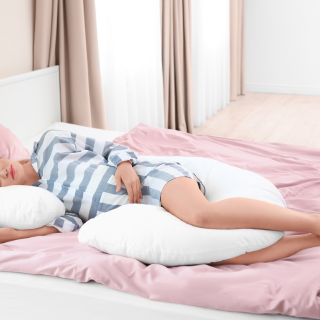
Side sleeping
-
Achieves neutral alignment of the spine, provided your mattress isn’t sagging and you’ve placed a pillow between your legs.
-
Ideal for those with sleep apnia or breathing issues as gravity won’t compress airways.
-
Best sleeping position for pregnancy as it promotes optimal blood flow to baby.
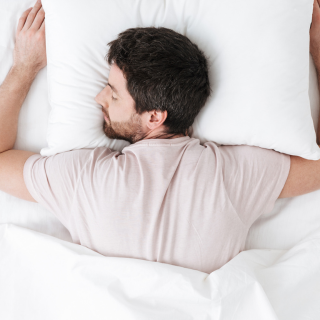
Tummy sleeping
✗ Requires neck rotation and unnecessary extension resulting in joint, ligament and muscle strain.
✗ Causes nerve compression and reduced blood flow leading to numbness and tingling in the upper limbs and hands.
✗ Places increased pressure on the lumbar (lower) spine via excessive arching of the back.
Choosing the right pillow
A pillow should support your preferred sleep position rather than fight against it. The aim is to support the head and neck so the body is not spending the whole night compensating for poor height, poor firmness or poor shape.
In general avoid very soft, cheap pillows that collapse too easily and replace pillows once they lose shape and structure.
Choose a pillow height that supports the sleep position you prefer most
As a guide –
- choose a pillow height that more closely takes into account your ear-to-shoulder distance in the sleep position you use most
- look for something supportive with a contour that helps maintain the natural curve of your neck.
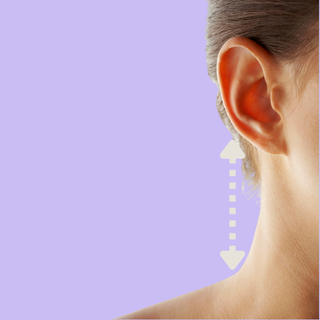
Shoulder to ear distance
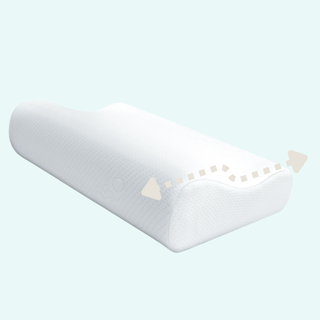
Contoured pillow
The right pillow height depends a lot on how you usually sleep. As a general guide, back sleepers and side sleepers need slightly different support to help keep the neck and spine in a more neutral position through the night.
Specific advice for –
Back sleepers
- pillow height should usually be slightly less than your shoulder-to-ear distance
- the pillow should feel like it stops your head from rolling sideways
Side sleepers
- pillow height should match your shoulder-to-ear distance more closely
- the pillow should fill the gap between head and mattress without forcing the neck upward
- a pillow between the knees often helps reduce twisting through the spine and pelvis
When tummy sleeping becomes a problem
Tummy sleeping is not automatically catastrophic, but it is commonly the least supportive option for the neck and spine. It usually keeps the neck rotated for long periods, can increase lower back extension, and often leaves the shoulders and upper body in less comfortable positions through the night.
For some people, this contributes to morning neck pain, shoulder tightness, numbness in the arms or hands, and a body that feels more irritated rather than restored. If that pattern sounds familiar, tummy sleeping may be worth changing gradually rather than trying to force an overnight switch.
How to shift away from tummy sleeping gradually
Changing sleep position usually works better when it is trained gradually, not forced all at once. For some people this shift happens quickly. For others, it takes weeks or months before the new position starts to feel natural. The goal is steady retraining, not perfection.
Week 1
Step 1 – Get comfortable on your back or side. If on back, place a pillow under your knees. If on side, place a pillow between your knees.
Step 2 – Stay put for 10 mins – this is essential. After 10 minutes you can move into a different position if you wish.
Step 3 – Rinse and repeat for 7 consecutive days.
Week 2
Step 1 – Get comfortable on your back or side. If on back, place a pillow under your knees. If on side, place a pillow between your knees.
Step 2 – Stay put for 20 mins. After 20 minutes you can move into a different position if you wish.
Step 3 – If you wake on your tummy during the night, get back to your new sleep position and stay put for 10 mins. After 10 minutes you can move into a different position if you wish.
Step 4 – Rinse and repeat for 7 consecutive days.
What helps the body settle before bed
Sleep quality is not just about position. It also helps if the body is able to settle before bed rather than carrying stress and tension straight into sleep.
A simple wind-down routine may help:
- keep your bedroom dark, quiet and cool
- keep wake and sleep times more consistent
- reduce screen exposure before bed where possible
- get daylight exposure during the day
- use gentle stretching or quiet movement if the body feels wound up
- use slower nasal breathing to help the body downshift before sleep
Diaphragmatic breathing through the nose
Simple diaphragmatic breathing can be a useful pre-sleep tool. The aim is not to breathe “perfectly,” but to let the ribcage, abdomen and diaphragm do more of the work rather than breathing shallowly through the upper chest.
A useful pattern to try:
- Inhale deeply through your nose for 4 seconds while engaging your diaphragm. Feel your belly expand.
- Hold for 2 seconds
- Exhale through your nose for 8 seconds. Feel your rib muscles relax and your belly passively flatten again.
This can be a simple way to help reduce tension before sleep, especially if stress is part of the picture. If sleep quality feels like part of a bigger issue, our Sleep page may be a useful next step.
Sleeping on planes and while travelling
Travel sleep is rarely ideal, but a few small choices can help reduce strain. If you are sleeping upright on a plane, the main priorities are supporting the neck, reducing how far the head drops or twists and avoiding being stuck in one uncomfortable shape for too long.
Helpful strategies can include:
- using a really supportive neck pillow that limits side-bending
- keeping the lower back supported with a small towel or jumper
- doing a few gentle neck and shoulder resets after longer periods of sitting
- If you can, see your chiropractor before and after the trip. It helps your body tolerate the travel better and makes it easier to settle any stiffness or aggravation afterwards.
When sleep posture needs proper assessment
Better sleep posture, more appropriate pillow support, less time spent in high-strain positions and a body that is better able to settle before bed often make the biggest difference over time.
However, it’s worth getting assessed properly if:
- you keep waking with pain, stiffness or irritation
- symptoms are worsening over time
- numbness or tingling is becoming frequent
- the issue is affecting sleep quality consistently
- you are unsure whether the problem is really coming from your sleep setup or from something more specific through the neck, shoulder or back
Sometimes it may be a more specific biomechanical issue that needs proper assessment and a clear treatment plan.
Need a clearer next step?
If you’re waking up feeling compromised, irritated and overnight pain is affecting how your body feels, the next step may be to understand the first appointment process, explore the chiropractic or speak with someone directly.